
By Brandon Monceaux
There’s a question we’ve been asking every building materials client lately: “What happens when someone types your product category into ChatGPT?”
The answers range from uncomfortable silence to genuine surprise. A competitor shows up. Sometimes an influencer does. Occasionally, nobody does—which is actually the bigger opportunity.
If you’re a CMO or on the marketing team for a building materials manufacturer, here’s why you should audit your marketing content for AI opportunities, what you’ll likely find, and what to do about it.
The misconception you need to drop first.
Most building materials marketing leaders fall into one of two camps:
- “AI isn’t relevant to our industry.” (It is.)
- “We already do SEO, so we’re covered.” (Not entirely.)
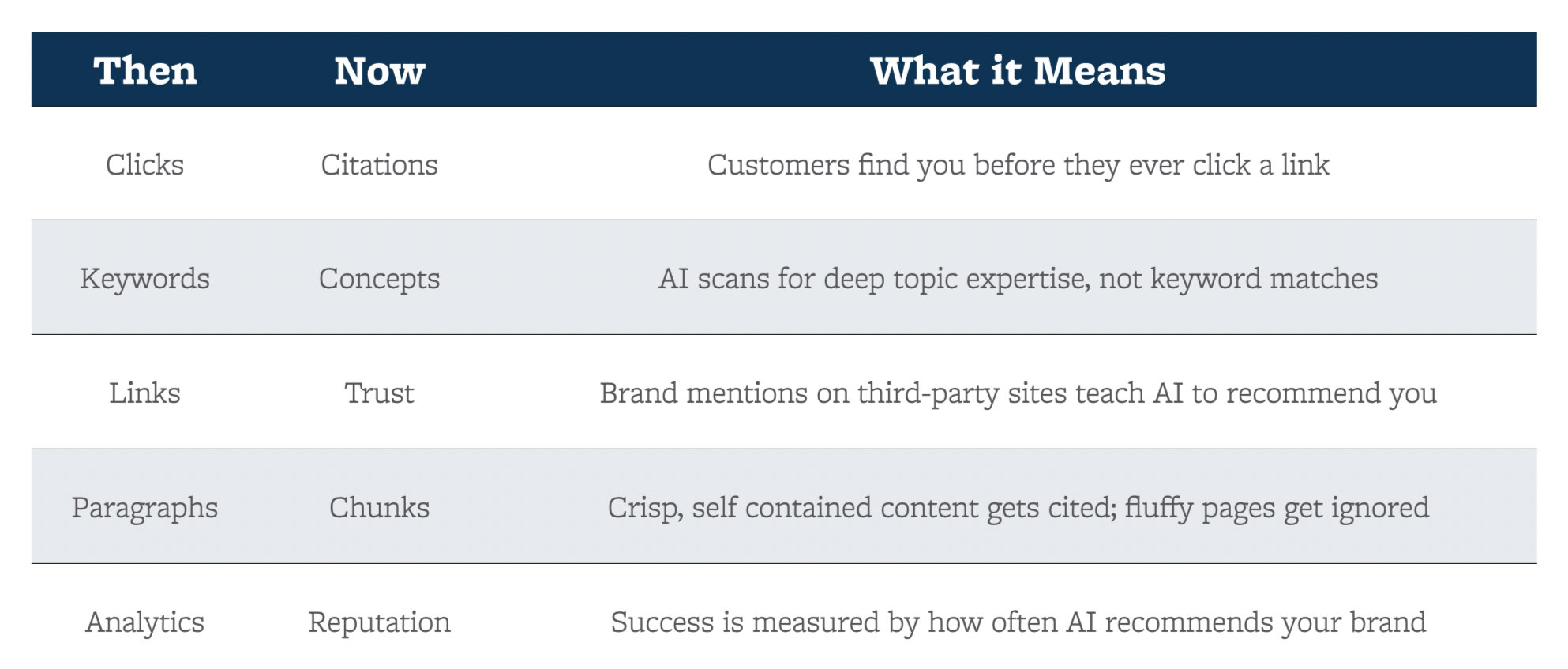
SEO and AI optimization are related, but they are not the same thing. Traditional SEO earns clicks by ranking links. AI search optimization—often called Generative Engine Optimization (GEO)—ensures your brand gets cited inside AI-generated answers in tools like ChatGPT, Perplexity, Claude, and Google’s AI Overviews.
The shift comes down to five key changes:
The CMO who has been doing SEO for 10 years isn’t wrong—they just have an incomplete picture.
What an AI marketing audit actually examines.
A proper audit reviews five areas:
- Technical SEO Health. AI can’t cite content it can’t find. The audit checks crawlability, canonical errors (when a site has duplicate or highly similar content across different URLs, so search engines can’t prioritize), redirect chains, duplicate tags, and thin content pages—all of which directly affect your brand’s visibility in AI-generated answers and overall search rankings, impacting lead generation and market reach.
- Keyword & Content Gap Analysis. This is where the most surprising discoveries happen. We recently audited a major building materials manufacturer and found they had strong keyword visibility for their core product line—but virtually zero organic search for an entire segment of their business. Their product portfolio is wide, but the market only knew them for one thing. After creating SEO and AI-optimized content that targeted the questions buyers were actually asking, they went from 1 keyword ranking to 386 keywords.
- AI Overview & LLM Visibility. We track which keywords trigger AI Overviews in Google—and whether your brand appears in them. In a recent audit, 63% of a client’s tracked keywords already triggered an AI Overview, but the brand appeared in fewer than 25% of them. That’s a significant, closeable gap.
- Schema Markup & Structured Data. Most building materials companies have an enormous amount of valuable technical content: product specs, certifications (LEED®, ASTM, ICC, UL), installation guides, and FAQs. The problem is that it’s often buried in PDFs or unstructured pages that AI systems can’t read. Schema markup is the translation layer that makes your expertise on your website machine-readable—and citable.
- Competitor Benchmarking. Where are your competitors showing up that you aren’t? What content formats—such as detailed FAQs, technical guides, or case studies—are earning them AI visibility? A keyword gap analysis reveals actionable opportunities to adopt these formats and improve your AI presence.
The four pillars of AI visibility.
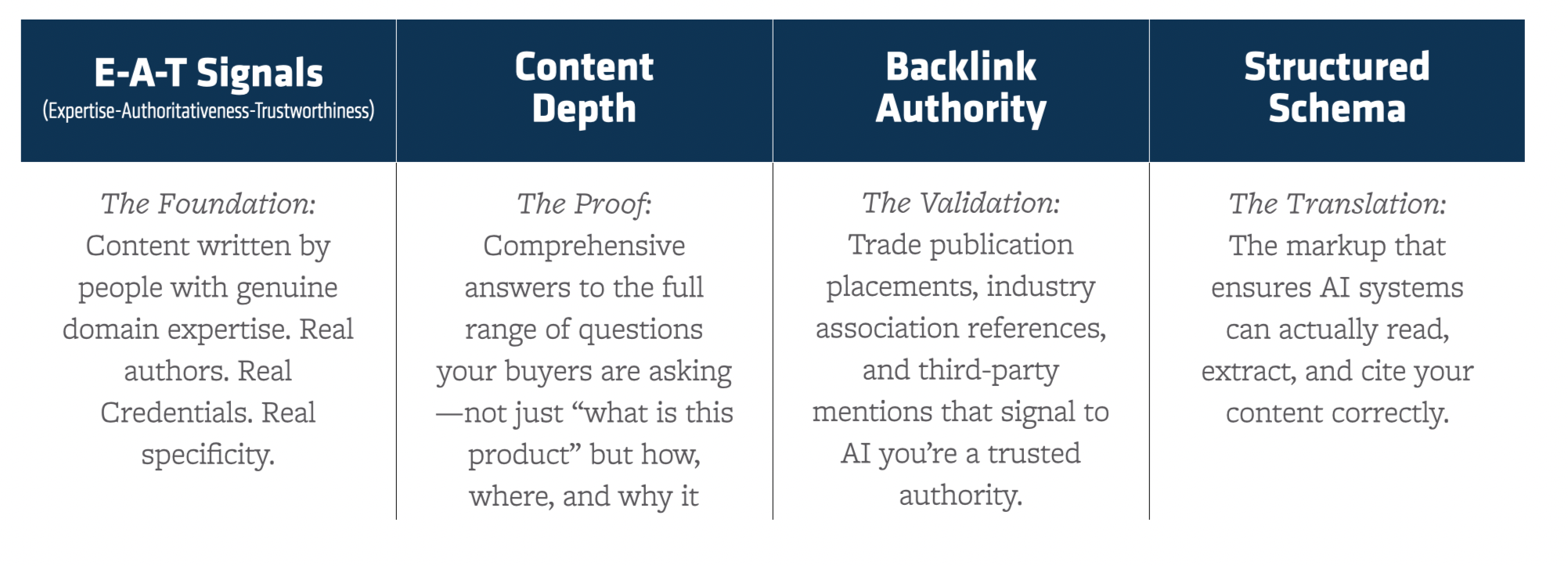
These four factors drive AI visibility. They’re equally important in execution, but they build on each other:
- E-A-T (Expertise – Authoritativeness – Trustworthiness) Signals
The Foundation: Content written by people with genuine domain expertise. Real authors. Real credentials. Real specificity. - Content Depth
The Proof: Comprehensive answers to the full range of questions your buyers are asking—not just “what is this product” but how, where, and why it matters. - Backlink Authority
The Validation: Trade publication placements, industry association references, and third-party mentions that signal to AI you’re a trusted authority. - Structured Schema
The Translation: The markup that ensures AI systems can actually read, extract, and cite your content correctly.
Insights to action.
Once your audit is complete, you’ll have a clear picture of where the gaps are, and that’s where the real work begins. Here’s how to turn those findings into a 30-60-90-day action plan.