

By Libby Boulais
Spend enough time in a marketing meeting, and you’ll hear some version of this:
“We already have brand awareness. What we need are leads.”
It’s a reasonable instinct. Leadership teams feel pressure to deliver growth, and leads seem tangible, measurable, and immediate. But the reality is that when marketing focuses only on the bottom of the funnel, performance doesn’t improve. It plateaus, and often, it declines.
The truth is that every part of the funnel helps drive lead generation.
The false divide between brand and demand.
In many organizations, brand marketing and performance marketing are treated as separate disciplines:
- Brand = Awareness, impressions, “nice to have”
- Performance = Leads, conversions, “must have”
That divide is not only outdated, it’s also counterproductive. To clarify, your brand is the meaning and emotional connection your company creates in your audiences’ minds. Branding refers to the tangible elements, such as your logo and campaigns, that express that meaning.
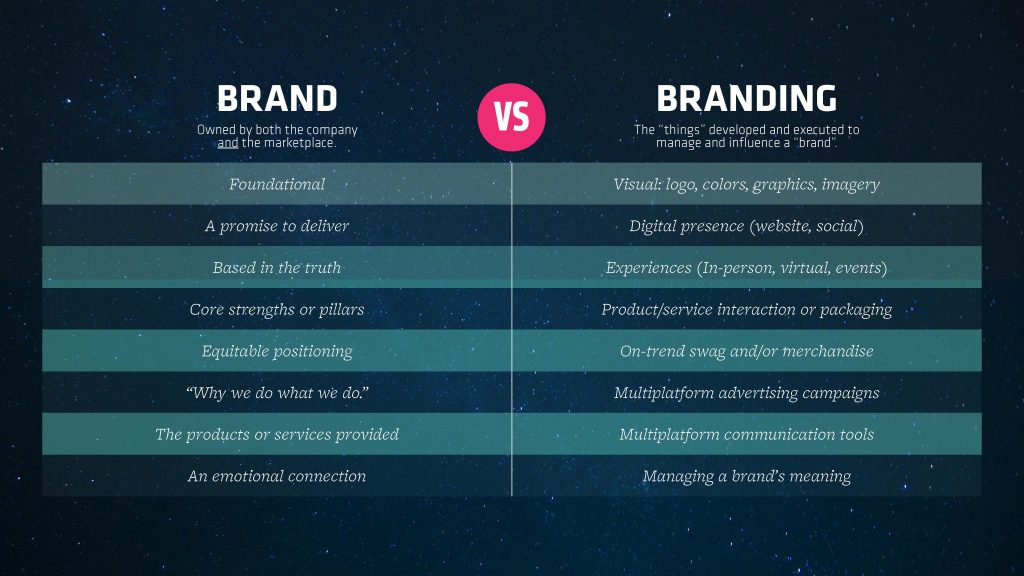
As the graphic shows, your brand is not your logo or your campaigns. Brand is the promise you make, the perception you create, and the emotional connection you build. Branding is how that meaning appears in the world.
When organizations say they “already have brand awareness,” they are often referring to branding outputs—not real market understanding. This misunderstanding leads to underinvesting in what actually creates demand.
The reality of how buyers actually buy.
In complex B2B environments, buyers do not move directly from awareness to purchase. They discover brands through many touchpoints and build familiarity over time. They enter and leave the market as needed—and most importantly, they are drawn to brands they already know.
Research shows that only about 5% of B2B buyers are actively in the market at any time. The other 95% are future buyers (Gale, 2026). If your brand does not appear early, you are not just missing leads—you are missing the chance to be considered at all.
By the time a form is filled out, much of the decision has already been shaped.
What a full-funnel strategy actually looks like.
A full-funnel strategy ensures your brand appears at every stage, not just at the conversion stage.

- Awareness is where buyers first encounter your brand, whether through PR, events, media, social content, or digital advertising. The goal is to earn attention and spark interest.
- Consideration builds on that foundation with deeper content, such as case studies, email nurturing, and targeted messaging, which helps buyers evaluate their options.
- Action-focused tactics, like paid search, retargeting, and sales outreach, turn that interest into leads.
These efforts are not isolated. They are connected, build on each other, and reinforce one another.
Every stage of the funnel is lead generation.
One of the biggest misconceptions in marketing is that lead generation only happens at the bottom of the funnel.
In reality, it starts much earlier.
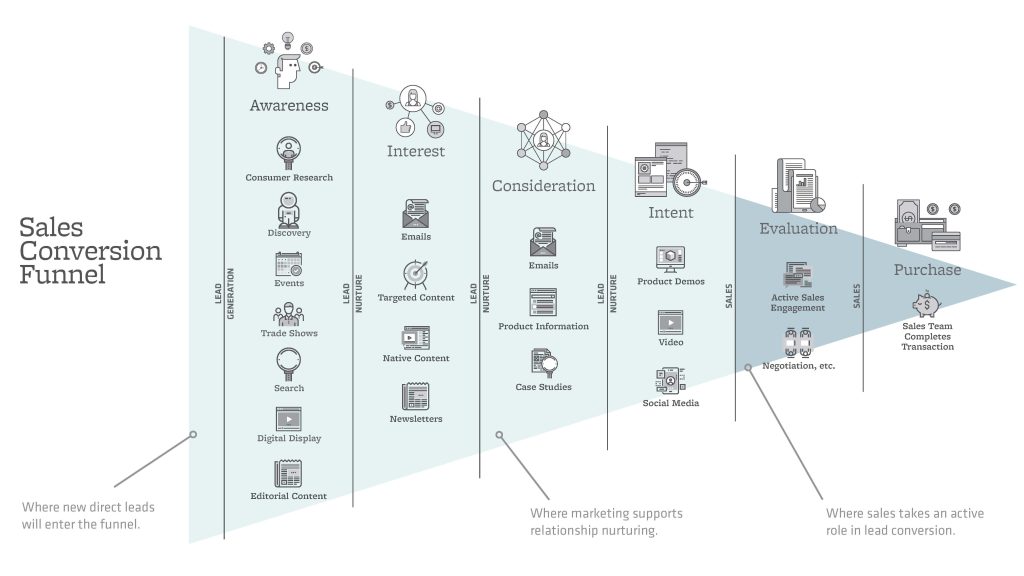
As this model shows, lead generation starts at the awareness stage, through discovery, search, events, and content. From there, marketing nurtures prospects through interest, consideration, and intent, before sales becomes more involved.
If you remove the top of the funnel, the entire system becomes weaker.
- Fewer prospects enter the pipeline.
- Nurturing becomes less effective.
- Conversion rates decline.
This is not a simple, linear funnel. It is an interconnected system.
Why awareness and performance work better together.
There is growing evidence that brand and performance marketing do not compete; instead, they strengthen each other (Cox, 2025).
Decades of research show that the most effective strategies balance long-term brand building with short-term activation. In many cases, this balance leans more toward brand building to support growth over time (Dyson, 2020).
The reason is simple: Familiarity reduces friction.
When awareness is strong:
- Paid media performs more efficiently.
- Conversion rates improve.
- Cost per lead decreases.
When awareness is cut:
- Performance becomes more expensive.
- Lead quality declines.
- Sales cycles stretch.
Performance marketing captures demand, while brand marketing creates it.
You need both.
When “We just need leads” is the wrong diagnosis.
When leadership asks for more leads, it is often a symptom, not the root cause.
The real issue is usually upstream:
- Low visibility
- Weak differentiation
- Lack of familiarity or trust
In other words, it is a top-of-funnel problem that looks like a bottom-of-funnel request.
The long game that drives short-term results.
Often, the fastest way to improve short-term lead generation is to invest in long-term brand building.
Because when your brand is known:
- Buyers come to you sooner.
- Sales conversations start further along.
- Marketing becomes more effective without increasing costs.
It’s not about choosing between awareness and performance.
It is about understanding that awareness is what makes performance possible.
Final thought.
The best marketing strategies do not chase leads. They create the right conditions for leads to happen. This means showing up early, showing up often, and being present throughout the entire funnel. The brands that succeed are not the ones shouting at the point of conversion. They are the ones buyers already trust by the time they are ready to buy—a principle proven by the most effective marketing approaches.
If your team feels pressure to deliver more leads, it might be time to look upstream. Miller Brooks helps brands build full-funnel strategies that drive immediate progress and performance.